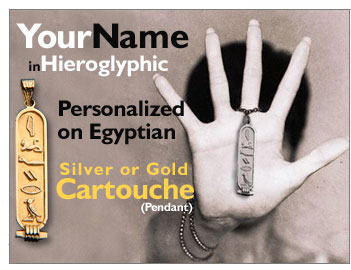
hieroglyphics was a way of writing formed by ancient Egyptians during their development stages. ancient Egyptians used pictures that stood for different letters. hieroglyphs formed the basic writing system of ancient Egypt, took shape around 3000 bc, and reached an accepted form as early as the first dynasty. there were thousands of signs, described by the Egyptian as "divine words."
writing texts are concerned with everything intended to be captured in writing for eternity, in particular religious texts, historical and political inscriptions, and biographies.
hieroglyphs were carved or painted on the walls of temples and tombs, on burial equipment, on pieces of egyptian jewelry, and on false doors.
|
| |
each symbols in egyptian writing alphabet represented an actual thing that existed in ancient egyptian life, plants, geometric figures, body parts, and birds. these signs could be used either to write the words they depicted, called ideograms, or to spell out the sounds of the words, called phonograms.
scribes had to learn more than 700 signs representing ideas and objects; others representing sounds. because the language was so complex, young scribes-almost always boys from wealthy or royal families-would attend school for years to become adept at writing and reading. and the training was rigorous. boys as young as six or seven would practice writing on ostraca-flat stones or broken pieces of clay pottery or cartouche . archaeologists have found many ostraca with texts of amusing animal tales or stern moral tracts that were dictated by the scribal teachers. students also had to learn mathematics so that a number of high-level professions would be open to them: tax collector, treasurer, quartermaster or architect.
rosetta stone the meaning of the egyptian symbols comes from the discovery of the a basalt rock inscribed with a message written in three languages: egyptian hieroglyphic, egyptian demotic and greek. the rosetta stone founded by napoleonic soldiers in 1799
the stone is a compact slab of basalt with dimension of (114x72x28 cm) ,and found in july 1799 in the egyptian village called rosette (raschid), located in the western delta of the nile. the stone is kept at the british museum in london.
|